Low-Carb Vegetable Rankings Based on Net Carbs and Micronutrients
Choosing low-carb vegetables sounds easy until you start comparing what is actually inside them.
A vegetable with one fewer gram of carbohydrate is not automatically the better nutritional choice, especially if another option gives you significantly more vitamin C, folate, potassium, or vitamin K.
That is where low-carb vegetable rankings based on net carbs and micronutrients become more useful than a simple carb chart. Instead of looking at carbohydrate content alone, this approach considers how much nutritional value you get for those carbs.
For consistency, the rankings below compare roughly 100 grams of raw vegetables. Net carbs are estimated by subtracting dietary fiber from total carbohydrates.
It is worth noting that “net carbs” is not an official FDA-defined nutrient, and the American Diabetes Association recommends paying attention to total carbohydrate as well, particularly for people managing blood glucose.
With that in mind, let’s see which vegetables deliver the strongest low-carb nutritional package.
How These Low-Carb Vegetables Are Ranked
A pure low-carb ranking would simply put the vegetable with the smallest number of digestible carbohydrates at the top. That is useful, but it leaves out half the picture.
This ranking also considers major micronutrients such as vitamin C, vitamin K, folate, potassium, magnesium, iron, selenium, and vitamin A. Fiber matters too because it reduces the estimated net-carb figure while supporting overall dietary quality.
The numbers should be treated as practical estimates rather than laboratory-perfect constants. Nutrient content can vary with variety, growing conditions, storage, and database updates.
| Rank | Vegetable | Approx. Net Carbs/100 g | Major Nutritional Strength |
|---|---|---|---|
| 1 | Spinach | 1.4 g | Vitamin K, Folate, Vitamin A, Potassium |
| 2 | Asparagus | 1.8 g | Folate, Vitamin K, Iron |
| 3 | White Mushrooms | 2.3 g | Selenium, Copper, B Vitamins |
| 4 | Zucchini | 2.1 g | Vitamin C, Potassium |
| 5 | Cauliflower | 3.0 g | Vitamin C, Folate |
| 6 | Broccoli | 4.0 g | Vitamin C, Vitamin K, Folate |
| 7 | Red Bell Pepper | 3.9 g | Exceptional Vitamin C |
Notice that the ranking is not simply sorted from lowest to highest carbs. Micronutrient density changes the final order.
1. Spinach: The Best Overall Nutrient-to-Carb Ratio
Spinach earns the top position because it combines exceptionally low net carbohydrates with an impressive range of vitamins and minerals.
Raw spinach contains about 3.63 grams of total carbohydrate and 2.2 grams of fiber per 100 grams, leaving approximately 1.43 grams of estimated net carbs. Yet the same amount provides around 558 mg of potassium, 79 mg of magnesium, 194 mcg of folate, and exceptionally high vitamin K.
Its vitamin K content is particularly notable at roughly 483 mcg per 100 grams. It also supplies vitamin A, vitamin C, iron, and several antioxidants.
That makes spinach incredibly efficient if you want to increase micronutritents without using much of your carbohydrate allowance.
Use it raw in salads, fold it into scrambled eggs, or lightly sauté it with olive oil and garlic. Just remember that spinach shrinks dramatically when cooked, so eating 100 grams cooked is very different from casually adding a few raw leaves to a sandwich.
2. Asparagus: Low in Carbs and Surprisingly Rich in Folate
Asparagus is another excellent choice for low-carb eating, especially if you want something more substantial than leafy greens.
A 100-gram serving contains approximately 3.88 grams of carbohydrate and 2.1 grams of fiber. That works out to around 1.78 grams of estimated net carbs.
Its real advantage is its nutritional variety. Asparagus provides about 52 mcg of folate, 41.6 mcg of vitamin K, 2.14 mg of iron, and modest amounts of vitamin C and vitamin E.
Roasting asparagus with olive oil, black pepper, and a little Parmesan is an easy low-carb side dish. It also works well alongside eggs, salmon, chicken, or tofu.
For anyone trying to build more nutritionally complete meals, asparagus offers a very strong carb-to-nutrient tradeoff.
3. White Mushrooms: A Different Kind of Micronutrient Powerhouse
Mushrooms deserve a high ranking because their nutrient profile is quite different from most green vegetables.
One hundred grams of raw white mushrooms contains approximately 3.26 grams of carbohydrate and 1 gram of dietary fiber, producing roughly 2.26 grams of net carbs. They also provide about 3.09 grams of protein, which is fairly useful for a vegetable-like food.
Where mushrooms really stand out is minerals.
The same serving contains around 318 mg of potassium, 9.3 mcg of selenium, and 0.318 mg of copper. USDA-derived data also shows a relatively strong contribution from several B vitamins.
That makes mushrooms a smart way to diversify a low-carb diet instead of eating leafy greens at every meal.
Try sautéing them with eggs, adding them to chicken dishes, or using large mushroom caps as a base for low-carb toppings.
4. Zucchini: One of the Most Versatile Everyday Choices
Zucchini may not dominate any single vitamin category, but its combination of low carbs, mild flavor, and flexibility makes it extremely practical.
USDA-derived data for raw zucchini shows around 3.1 grams of total carbohydrate and approximately 1 gram of fiber per 100 grams, giving roughly 2.1 grams of net carbohydrates. It also supplies around 261 mg of potassium and nearly 18 mg of vitamin C.
Some newer USDA Foundation Food entries report slightly different carbohydrate and fiber values, which shows why food databases do not always produce identical numbers.
From a meal-planning perspective, zucchini is incredibly versitile. You can spiralize it into noodles, grill it, roast it, stuff it, or grate it into egg-based dishes.
Its neutral flavor also makes it easy to pair with stronger ingredients without overwhelming the meal.
5. Cauliflower: The Low-Carb Substitute Champion
Cauliflower became famous in low-carb diets because it can replace several higher-carbohydrate foods, but its nutritonal value deserves just as much attention.
Raw cauliflower provides about 4.97 grams of carbohydrate and 2 grams of dietary fiber per 100 grams. That produces approximately 2.97 grams of net carbs.
More importantly, it provides around 48.2 mg of vitamin C and 57 mcg of folate per 100 grams, plus smaller amounts of vitamin K and several B vitamins.
Cauliflower rice is probably its most famous use, but it is far from the only option. You can roast florets until caramelized, mash cauliflower instead of potatoes, blend it into soups, or bake it with herbs and cheese.
Its biggest advantage is not simply low carbs – it is how easily it can replace starchier foods without making meals feel unusually restrictive.
6. Broccoli: Slightly More Carbs, Much More Nutritional Value
Broccoli illustrates why ranking vegetables purely by carbohydrate content can be misleading.
At approximately 6.64 grams of carbohydrate and 2.6 grams of fiber per 100 grams, broccoli provides around 4.04 grams of estimated net carbs. That is higher than spinach or asparagus, but still very reasonable for most low-carb meal plans.
In return, broccoli provides about 89.2 mg of vitamin C, 101.6 mcg of vitamin K, 63 mcg of folate, and roughly 316 mg of potasium.
Using the FDA’s current Daily Value of 90 mg for vitamin C, 100 grams of raw broccoli provides close to an entire Daily Value.
That is an excellent nutritional return for roughly four grams of net carbohydrates.
Broccoli works particularly well steamed lightly, roasted, stir-fried, or paired with protein and healthy fats.
7. Red Bell Pepper: Worth the Carbs for the Vitamin C
Red bell pepper comes near the bottom of this ranking only because its carbohydrate level is slightly higher – not because it lacks nutritional value.
A 100-gram serving contains about 6.03 grams of total carbohydrate and 2.1 grams of fiber, producing approximately 3.93 grams of net carbs.
What you get in exchange is extraordinary vitamin C density.
Raw red bell pepper provides around 127.7 mg of vitamin C per 100 grams, comfortably exceeding the FDA Daily Value of 90 mg for adults and children aged four and older.
That makes red pepper a perfect example of why the lowest-carb vegetable is not always automatically the most valuable one.
Slice it into salads, add it to stir-fries, roast it alongside zucchini, or eat smaller portions with dips if you are closely tracking carbohydrates.
Net Carbs Should Not Be the Only Number You Watch
It is tempting to turn low-carb eating into a mathematical competition where the food with fewer carbohydrates always wins.
Nutrition does not really work that way.
For example, choosing broccoli instead of zucchini may cost you roughly two additional grams of net carbohydrates per 100 grams, but broccoli provides substantially more vitamin C and vitamin K.
Likewise, red pepper contains more carbs than spinach but delivers exceptional vitamin C.
The FDA recommends looking at a food’s broader nutrient profile, with nutrients such as dietary fiber, vitamin D, calcium, iron, and potassium among those consumers are encouraged to get adequate amounts of.
A smart low-carb diet therefore focuses on nutrient density per carb, not simply the smallest possible carb number.
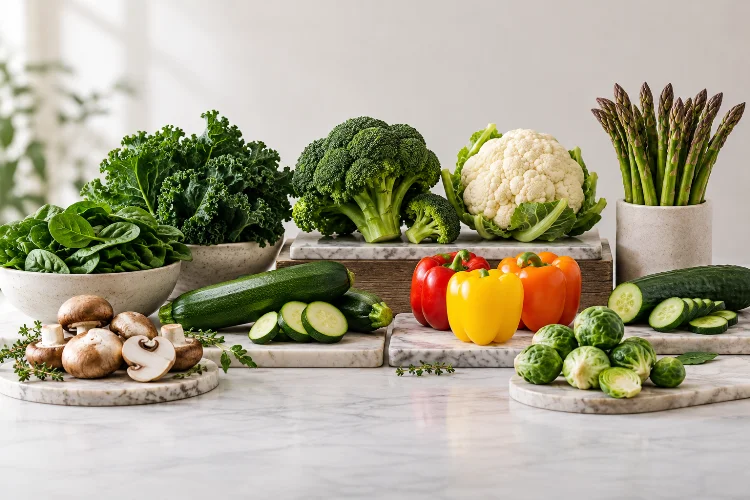
The best low-carb vegetable rankings based on net carbs and micronutrients show that there is no reason to choose vegetables using carbohydrate content alone.
Spinach and asparagus offer excellent nutrient density at extremely low net-carb levels, while mushrooms bring useful minerals and B vitamins.
Zucchini and cauliflower provide flexibility, while broccoli and red bell peppers justify slightly higher carb counts with impressive vitamin content.
Instead of eating the same “lowest-carb” vegetable every day, rotate several options. Different colors and plant families provide different combinations of vitamins, minerals, fiber, and phytonutrients.
Next time you plan a low-carb meal, ask more than “How many carbs does this have?” Ask what nutrition you are getting for those carbs. That simple shift can make your meals much more balanced.