Mobile Gaming Technology: 7 Features Changing How We Play
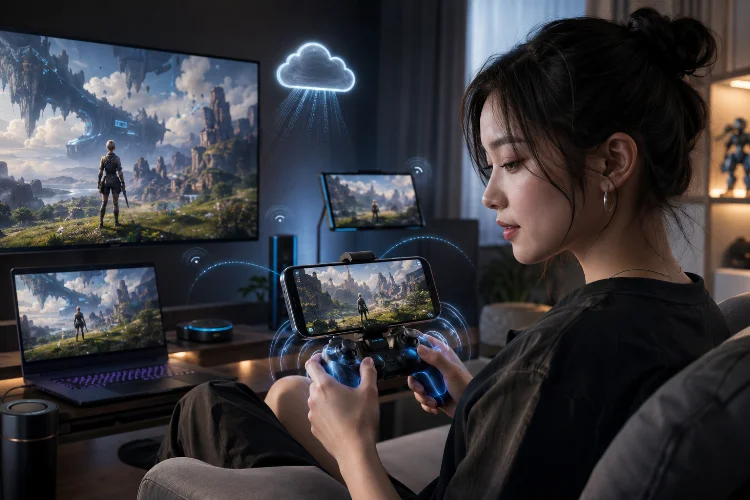
Mobile gaming is no longer limited to tapping virtual buttons on a small screen. Players can now connect physical controllers, stream console games through the cloud, continue supported games on a PC, experience detailed haptic feedback, and enjoy graphics that increasingly resemble dedicated gaming systems.
Much of this transformation comes from improvements in Mobile Gaming Technology rather than any single game.
Faster networks reduce communication delays, cloud platforms move demanding computing away from the phone, and powerful graphics processors make native games increasingly ambitious. At the same time, cross-device ecosystems are making the traditional boundaries between mobile, PC, and console gaming less obvious.
Here are seven technologies every modern mobile player should understand.
1. Cloud Gaming Moves Processing Away From Your Phone
Cloud gaming takes a different approach from normal mobile games.
Instead of rendering everything directly on the smartphone, much of the game runs on remote servers. Video is streamed to the player while controller or touchscreen inputs travel back to the server.
Xbox Cloud Gaming, for example, supports streaming compatible console games to phones, tablets, computers, consoles, and other supported devices. Microsoft notes that streaming quality depends heavily on internet connectivity, location, and device conditions.
This means an inexpensive device can potentially access games that would otherwise require considerably stronger local hardware.
2. 5G Can Help Reduce Network Delay
For competitive and cloud-based games, raw download speed is only part of the equation.
Latency—the time it takes information to travel between devices and servers—is also important. When latency becomes high, players may notice delayed actions or lag.
5G technology was designed partly around lower latency and higher network capacity compared with earlier mobile generations. Qualcomm identifies gaming and cloud applications among the experiences that can benefit from lower-latency 5G connectivity.
Real-world results still depend on coverage, network congestion, server location, and the specific game.
3. High-Refresh Displays Make Movement Feel More Responsive
A higher-refresh-rate screen can make scrolling and gameplay appear smoother when the game produces enough frames to take advantage of it.
Android devices commonly support options such as 90Hz and 120Hz. Google also notes that Android 15 defaults games to 60Hz unless developers explicitly request higher frame rates through supported APIs.
However, more is not always better.
Rendering additional frames can increase power consumption, so a stable 60 FPS experience may sometimes be preferable to an inconsistent 120 FPS mode.
4. Physical Controllers Turn Phones Into Handheld Systems
Touchscreens are excellent for many mobile games, but certain genres benefit from physical controls.
Racing games, platformers, fighting games, shooters, and cloud-streamed console titles can feel very different with analogue sticks, triggers, and physical buttons.
Both major mobile ecosystems now support gaming controllers in various forms. Apple provides a Game Controller framework for developers, while Microsoft’s cloud gaming service supports compatible Bluetooth and USB controllers.
Pairing a controller with a phone can effectively turn the device into a compact handheld gaming system.
5. Haptic Feedback Adds Another Layer of Immersion
Graphics and audio are not the only ways games communicate with players.
Haptics can make impacts, movement, weapons, vehicles, or environmental events feel more physical by creating carefully designed vibrations.
Apple’s Core Haptics framework allows developers to create customized tactile and audio feedback. The technology can also provide haptic effects through supported game controllers.
Well-designed feedback can make actions feel more responsive without requiring additional visual information on an already small screen.
6. Cross-Device Gaming Is Becoming More Important
A mobile game does not always have to stay on mobile.
Google Play Games supports gaming across Android devices and Windows PCs, including library and progress synchronization for supported experiences. Google currently describes a catalogue exceeding 200,000 games across its mobile and PC gaming ecosystem.
Microsoft takes a similar approach with cloud gaming and Remote Play, allowing supported games and progress to move between multiple device types.
For players, this means the phone increasingly acts as one screen within a much larger gaming ecosystem.
7. Advanced Graphics Are Reaching Smartphones
Modern mobile graphics have moved far beyond basic textures and simple lighting.
Android developers can use Vulkan to access modern GPU capabilities more efficiently, while Apple provides Metal for hardware-accelerated graphics on its devices.
Some Snapdragon platforms also support features such as hardware-accelerated ray tracing, advanced geometry rendering, and gaming-focused upscaling technologies.
These technologies help developers create more sophisticated lighting, environments, and visual effects while trying to keep performance and battery consumption manageable.
Modern Mobile Gaming Technology is making smartphones far more flexible gaming devices. Cloud services can stream demanding games, 5G can improve connectivity in suitable conditions, physical controllers offer precise input, and haptics make gameplay feel more immersive.
Cross-device ecosystems are also making it easier to move between phones and larger screens, while modern graphics APIs continue raising the visual ceiling for native games.
Players do not need every feature to enjoy mobile gaming. Instead, consider the games you actually play and choose technology that improves those experiences—whether that means better connectivity, smoother displays, a controller, or simply more consistent performance.