
Live Casino Games Work Explained: From Studio to Your Screen
A live blackjack table can appear effortless from the player’s side. You open the game, see a dealer shuffle or deal cards, tap your decision, and watch the round continue.
Behind that simple interface is a surprisingly complicated technology stack.
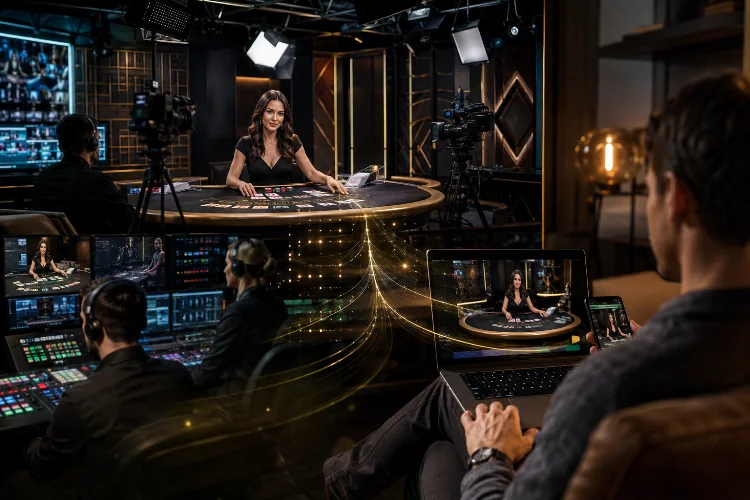
To understand how Live Casino Games Work, imagine a television broadcast connected to an interactive financial and gaming platform. The studio sends live video and audio, while separate software handles betting windows, player decisions, balances, settlement, chat, and other functions.
Large live casino providers operate purpose-built environments with cameras, control systems, trained presenters, and supporting IT infrastructure. Playtech says its live operation combines studio facilities with substantial investment in streaming technology, software, hardware, and presenter training.
The interesting part is how all those pieces remain synchronised.
1. The Studio Is Built More Like a Broadcast Facility
A live dealer studio might look like a casino on your screen, but behind the camera it has many characteristics of a television set.
There are controlled lighting conditions, cameras, microphones, monitors, production equipment, gaming tables, and operational staff.
Playtech’s Riga facility was built with hundreds of cameras, custom tables, monitoring facilities, and dealer-training infrastructure.
Evolution similarly describes its live studios as advanced TV or film-style facilities built around multi-camera, audio, and IT technology.
This controlled environment serves an important purpose.
Consistency matters when games may be broadcast continuously to thousands of remote users. Cards need to remain visible, dealers need reliable instructions, and game equipment must remain within camera coverage.
2. Live Video and Game Software Are Separate but Connected
The dealer video is what makes live casino look real, but the stream by itself would not let you gamble.
A second layer of software sits around the broadcast.
This interface displays betting areas, chips, countdowns, game history, account information, buttons such as Hit or Stand, and sometimes chat.
Evolution explains that players connect through a phone or computer while the supporting software lets them place bets, make game decisions, and interact with the dealer.
So when you place a blackjack wager, two things are happening simultaneously.
You are watching a physical table through live video, while the software records your participation in that particular round.
The system then has to keep those two timelines aligned.
3. Every Game Round Has a Digital Lifecycle
Consider a simplified roulette round.
First, betting opens.
Players submit wagers through the digital interface. The system records accepted bets and eventually closes the betting window. The dealer spins the wheel, the ball lands, the result is recorded, and the system calculates which accepted wagers win.
Then the next round begins.
Blackjack has more interaction because players may need to choose Hit, Stand, Double, or other options during the round.
The same basic principle remains: each action has to be associated with the correct game state.
UK Gambling Commission requirements say systems should process and settle wagers according to the operator’s published rules and the rules of the specific game.
This digital lifecycle is happening continuously while the player mainly sees a friendly dealer and a few buttons.
4. Latency Is One of the Biggest Technical Challenges
Live streaming is never literally instantaneous.
Video has to be captured, encoded, transmitted over networks, and displayed on the player’s device. Player commands then need to travel back toward the game system.
That creates latency.
Usually it is small enough that the experience still feels live, but timing matters when a decision must be made before a betting window closes.
The UK Gambling Commission directly addresses this issue in its rules for time-critical events. Where response speed significantly affects the chance of winning, operators must evaluate the risk and take reasonable steps to reduce unfair disadvantage.
The standards even identify network latency and device performance as factors that can affect players.
This is why the betting interface—not simply what you see in the video—is important for knowing whether wagers are still being accepted.
5. Multiple Camera Angles Help Players Follow Physical Results
Streaming quality is not only about resolution.
The player also needs to clearly see what happened.
Roulette is a good example. A wide camera may show the dealer and table, while another gives a closer view of the wheel.
Evolution’s Immersive Roulette uses a multi-camera setup and provides close views and slow-motion presentation around the roulette result.
Dedicated studio installations can also place several HD cameras around a single table. Evolution has previously described dedicated environments using Hollywood-style multi-camera arrangements.
The cameras make the result easier to follow, but the official settlement still comes from the game system operating under the published rules.
A replay is presentation.
Settlement is a transaction.
6. Dealers Are Only One Part of the Integrity Process
Live casino sometimes creates the impression that fairness depends entirely on whether the dealer looks trustworthy.
Real operations are more structured than that.
UK Gambling Commission rules for live dealer studios require operations to be independently auditable. The guidance covers dealer training, commercial-quality gaming equipment, supervision, video surveillance, secure access to gaming areas, and game logs.
That means the dealer is part of a wider operational system.
Supervisors may oversee dealing procedures. Surveillance can provide records of table activity. Equipment and consumables have access controls, while game events can be logged for later analysis.
These controls matter because physical games introduce operational risks that do not exist in exactly the same form in purely software-generated games.
7. What Happens If Your Internet Connection Drops?
This is one of the most practical questions about live online gaming.
Suppose you place a wager and your Wi-Fi disconnects before the dealer reveals the result.
Does the wager disappear?
Not necessarily.
Under UK regulatory guidance for interrupted gambling, if an operator has received a player’s gamble and the player can no longer influence the outcome, the result should normally stand. For games with multiple decision points, operators should take reasonable steps to restore the last known game state where applicable.
Specific treatment depends on the type of game and the applicable operator rules.
This illustrates why the digital transaction record matters.
Your phone losing the video stream does not necessarily mean the remote game itself stopped happening.
8. Security Protects More Than the Video Feed
A live casino platform processes considerably more than moving pictures.
It can handle account information, authentication, balances, wagers, settlement records, and communication between multiple systems.
Security therefore applies to the supporting remote gambling infrastructure, not simply to the cameras.
The UK Gambling Commission’s current remote technical standards include dedicated security requirements. Its framework incorporates a subset of controls based on ISO/IEC 27001 and applies technical and security obligations to relevant licensed remote operators and gambling software businesses.
In addition, live dealer studio standards require secure areas, equipment, and consumables to be protected from unauthorised access.
The glamorous studio is therefore only the visible side of a much larger infrastructure.
9. Live Casino Is Becoming More Than Traditional Table Games
The same infrastructure can support formats beyond straightforward blackjack, baccarat, and roulette.
Modern studios increasingly produce game-show-style experiences, branded environments, augmented-reality presentations, and hybrid formats combining physical hosting with digital elements.
Playtech’s current live portfolio includes traditional table games alongside live game shows and newer hybrid concepts.
Evolution likewise operates classic games and live game-show environments through the same broader live-casino ecosystem.
This evolution makes sense when you think of the studio as an interactive broadcast platform.
Once cameras, presenters, software, betting systems, and real-time streaming are connected, the format does not have to resemble a traditional casino table forever.
10. Regulation Still Depends on Where the Player Is Located
Live casino technology can cross borders easily.
Gambling law cannot always do the same.
Evolution notes that regulation differs significantly between markets, with some jurisdictions regulating online casino gambling nationally and others using regional or different licensing models.
That means the availability of a live game does not automatically establish that someone is legally permitted to use it.
For real-money participation, players should verify the operator and the rules applicable to their jurisdiction.
Technology can make a game available on a phone almost anywhere, but regulation determines where licensed real-money access is permitted.
Once the layers are separated, the way Live Casino Games Work is easier to understand.
The studio supplies the physical dealer and casino equipment. Cameras and microphones turn the table into a broadcast, while software records wagers and player decisions. Servers keep the game state organised, timing controls synchronise remote players, and settlement systems connect physical outcomes with digital balances.
Behind all of that are surveillance, training, security, logs, and regulatory procedures designed to support fair operation.
Next time you watch a dealer spin a roulette wheel, notice the interface surrounding the video. That digital layer is just as important as the studio itself—and together they create the live casino experience.